Battle of the grinders
Five electric grinders you can buy new in New Zealand today, from $288 to $1,983. The grinder matters more than the machine, so this is the purist's first purchase: real shelf prices, the makers' own pictures, an opinion we will put our name to — and your vote decides the champion.
 1
1CHEAPEST WAY IN
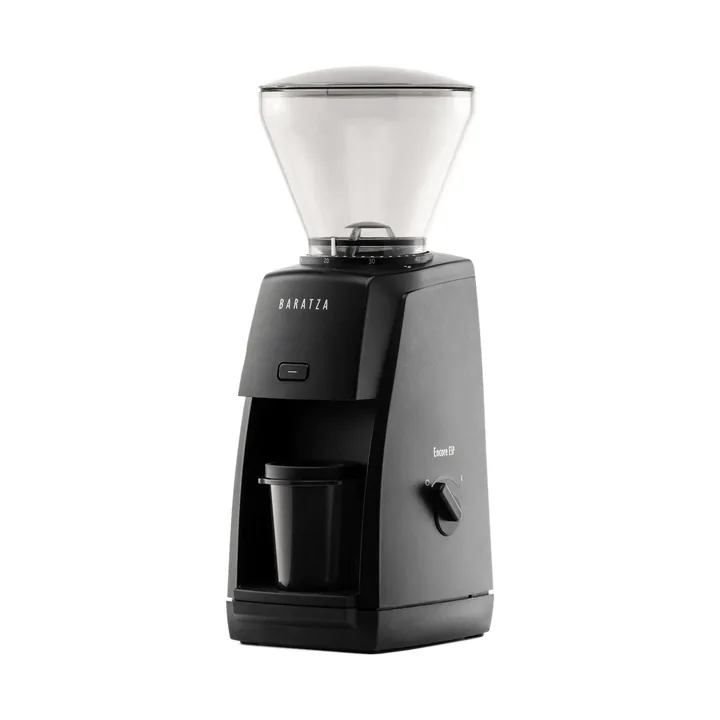
The filter grinder that learned espresso. Baratza took the Encore that half the pour-over benches in the country run on, tightened the bottom twenty settings to espresso resolution and put a dosing cup in the box. On the day we read it Harvey Norman had it marked down from $419 to $288, which makes it the cheapest honest way to feed a Dedica Duo or a Classic Evo Pro. It is plastic, and it is slow at espresso settings. It is also the grinder we would tell a purist to buy first.
- Burrs 40 mm conical steel (M2), quick-release, 550 rpm
- Adjustment 40 settings: 1-20 for espresso, 21-40 for filter, French press and cold brew
- Made for Espresso and filter
- Dosing Manual: a pulse button or the on/off knob; anti-static dosing cup for a 54 mm portafilter, with a 58 mm adapter
- Also stated 70 W; 300 g hopper, 120 g grounds bin; 1.3 g/s at setting 10, 2.2 g/s at 30; 13 x 15 x 34 cm, 2.5 kg; 24-month warranty
Photo: Baratza, the maker's own product picture, via baratza.com.
 2
2THE ALL-ROUNDER
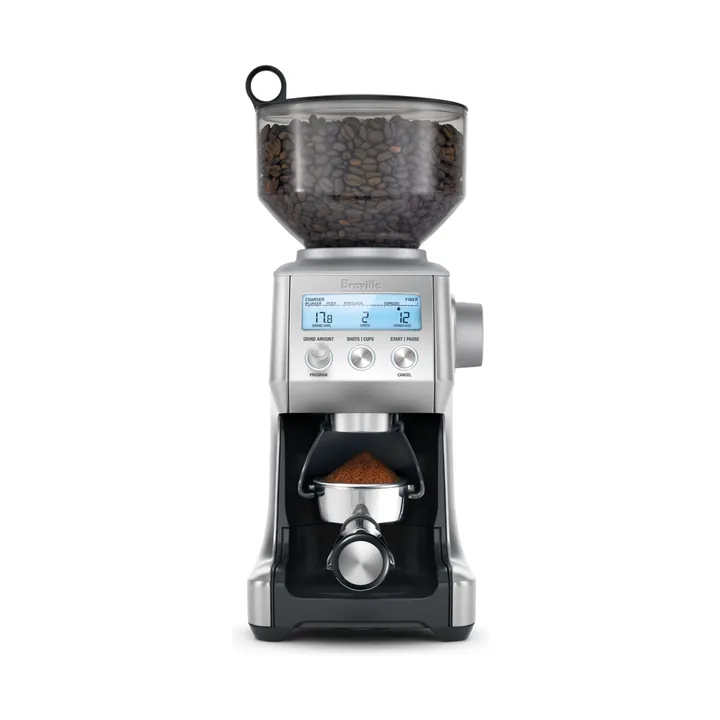
The appliance-shop answer, and not a bad one. Sixty settings from espresso to French press, a timer that doses by the shot or the cup, and a cradle for the portafilter, so it suits the household that wants one grinder for the AeroPress on weekdays and the machine on Sunday. Its espresso steps are coarse where the Encore ESP's are fine, it is the second Breville-group grinder on this page, and we saw it under $330 at another appliance chain the same day: shop around.
- Burrs Stainless steel conical
- Adjustment 60 grind settings
- Made for Espresso to French press: cradles for 50-54 mm and 58 mm portafilters, or it grinds into an airtight container, a gold-tone filter basket or a paper filter
- Dosing Adjustable: grind time programmed in 0.2-second steps, by 'shots' or 'cups', on an LCD (Dosing IQ)
- Also stated 165 W; 450 g hopper; auto power off; 21.4 x 16 x 38.9 cm; 24-month warranty
 3
3OUR PICK
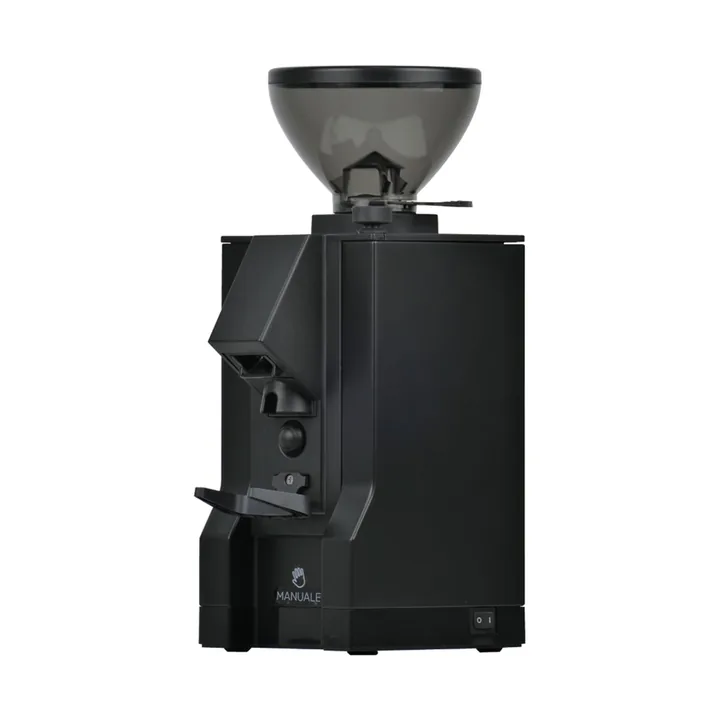
The purist's grinder, at the purist's price. Fifty-millimetre flat burrs, a stepless dial you turn by fractions, no timer and no screen: you hold the portafilter under the chute until the dose looks right, and you learn the sound. It is built in Florence by a company that has been grinding coffee since 1920, it is twelve centimetres wide, and it is what we would put beside a Classic Evo Pro or a Dedica Duo before either machine gets a single upgrade. Espresso first, and proud of it.
- Burrs 50 mm flat
- Adjustment Eureka stepless micrometric
- Made for Espresso (the maker's recommended use); a brew setting for filter†
- Dosing Manual, on demand: the portafilter presses the switch, take it away and it stops
- Also stated 310 W, 1,350 rpm; about 0.9-1.5 g/s; 150 g hopper; rated for 8 kg a week; 14 x 12 x 35 cm, 5.6 kg; handmade in Florence; 1-year warranty
† from Eureka’s own page for this grinder, read 6 Sep 2026; the rest is the shop’s listing.
Photo: Eureka, the maker's own product picture, via eureka.co.it.
 4
4FOR FILTER ONLY
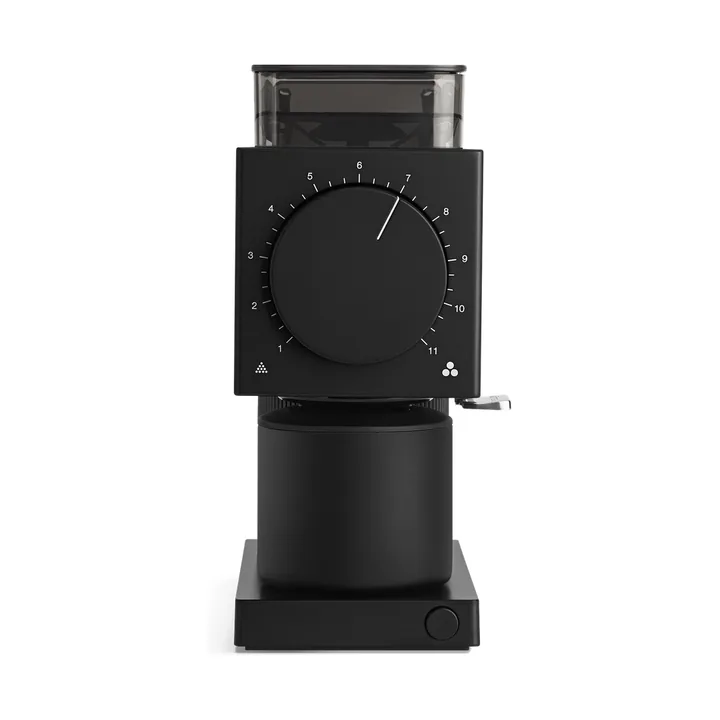
The grinder that refuses to make espresso, which is the most honest thing on this page. Sixty-four-millimetre flat burrs the size of a cafe's, thirty-one steps across the brewed range and not one of them fine enough for a shot, a single-dose hopper and a knocker so the last gram comes out. If your coffee is a V60, an AeroPress or a plunger and there is no machine in your future, this is the best cup on the page for the money. If there might be, it is the wrong grinder. Toasted is a roaster on our shelf, so this is the one link here the tracker visits every night.
- Burrs 64 mm flat, stainless steel, uncoated (Gen 2 Brew Burrs)
- Adjustment 11 settings with 31 steps in between
- Made for Brewed coffee: pour-over, drip, AeroPress, French press and cold brew. 'Ode is not intended for espresso'†
- Dosing Single dose: 100 g hopper, auto stop, a grinds knocker and a magnetically aligned catch cup
- Also stated Anti-static (retention down to about 0.1 g); grinds as fine as 250 microns; 239 x 105 x 248 mm, 4.5 kg; aluminium body
† from Fellow’s own page for this grinder, read 6 Sep 2026; the rest is the shop’s listing.
Photo: Fellow, the maker's own product picture, via fellowproducts.com.
 5
5THE DREAM
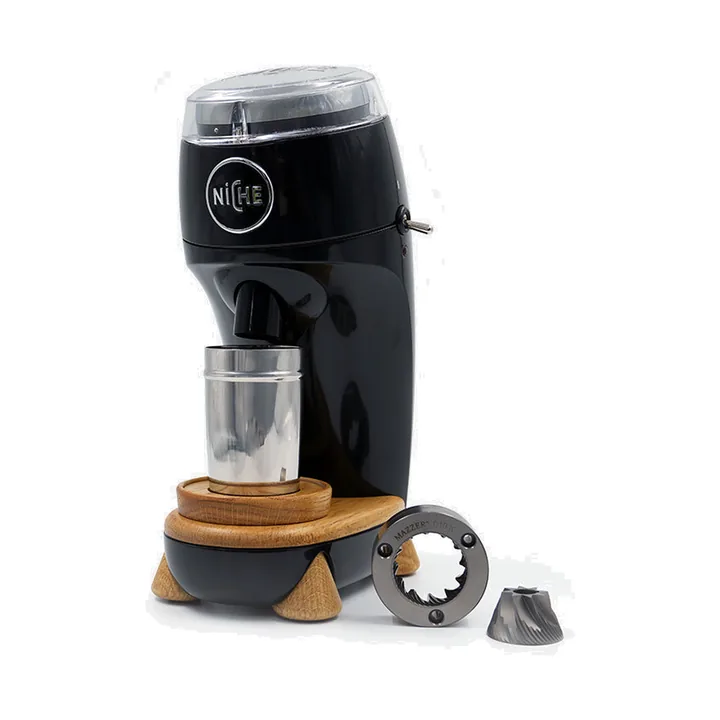
The one people save up for, and the only grinder here with no compromise to explain. Big conical burrs, a stepless dial, and a straight path from funnel to cup so that what you weigh in is what you get out, which is why it is the grinder behind every home-barista video you have watched. Espresso and filter, equally. It is also almost seven times the Encore ESP, and on the day we read it Di Pacci was the one New Zealand shop with it on a shelf; Niche also ships direct from Britain, and we did not price that road.
- Burrs 63 mm conical
- Adjustment Infinite stepless dial
- Made for Espresso and filter
- Dosing Single dose down a straight-through path; 58 mm grind cup; dose consistency within 0.2 g
- Also stated About 1 g/s; aluminium with real oak trim; 4.1 kg; grind cup, socket driver and brush in the box
Photo: Niche, the maker's own product picture, via nichecoffee.co.uk.
2 picks · 100%
How we check
One shop, one day, one shelf price each — this is a comparison you can check in a click, not a survey of the whole country. Prices read at each shop on 6 Sep 2026 and not checked since — 50 days ago, so check before you buy.
One grinder per reader. Change your mind as often as you like — the last pick is the one that counts, and the scoreboard is every reader's pick added up.
2 picks so far. Zero leads with 100%.
What we store
A pick is stored against a salted hash of your address, never the address itself. Same machine, same household, same office: one pick. Clearing your cookies or opening a private window does not buy a second one; the server is the record, and it keeps the last pick it was sent. The scoreboard on the page is counted from those picks each night and refreshed when you open the page.
Every machine on the other battle page can pull a good shot, and not one of them can pull a good shot from a bad grind. The grind is where the cup is decided: how fine, how even, how fresh. So this is the thing to buy before the machine, or before the machine gets its upgrade, and we ranked five of them the way we ranked the machines: real New Zealand shelf prices from a named shop, the specs that shop publishes, and a verdict we will put our name to.
Why these five
Five, and each one a different answer to the only question a bench asks: what do you brew? Espresso only, by feel (the Mignon Manuale). Filter only, and never espresso (the Ode Gen 2). Both, on a budget (the Encore ESP, with espresso resolution in the bottom half of its dial). Both, with a timer and a screen, for a household that brews three ways (the Smart Grinder Pro). Both, with nothing left behind, for the person who has already decided (the Niche Zero).
Bench grinders only. The hand grinders — the Comandante, the 1Zpresso, the Timemore you take camping — are a different purchase for a bench you do not have, and they get their own battle; this page links to it the day it is published. Two of these five are Breville-group grinders, because Breville bought Baratza in 2020 and the Encore ESP and the Smart Grinder Pro are still two different answers; we say so rather than pretend they are rivals from opposite ends of the earth.
Every one is sold new in New Zealand today, and together they run $288, $399, $649, $849 and $1,983, so the ladder is the argument laid out on a shelf. Considered and not used: the DF64, the enthusiast's value single-doser everywhere except here — on the day we looked the one New Zealand shop listing the Gen 2 new had it at $1,316 while an Australian specialist quoted $769 to ship one across, and a price that depends on which side of the Tasman you order from is not a shelf price; the plain Baratza Encore, which Baratza does not sell as an espresso grinder; the Fellow Opus, a second Fellow; and the Mahlkönig X54, out of stock at every shop we checked.
- OUR PICKMignon Manuale
Stepless, flat, Italian, and $649. It does one thing — espresso — and hands the whole job to you, which is exactly what a purist asked for. Put it beside the machine you already own before the machine gets its upgrade.
- CHEAPEST WAY INEncore ESP
Two hundred and eighty-eight dollars on the day, espresso resolution at the bottom of the dial and filter at the top. Start here, with fresh beans, and find out whether the machine was ever the problem.
- THE ALL-ROUNDERthe Smart Grinder Pro
Sixty settings, a timer that doses by the shot or the cup, a cradle for the portafilter: the grinder for a household that brews three ways and wants one box on the bench.
- FOR FILTER ONLYOde Brew Grinder Gen 2
Cafe-size flat burrs across the brewed range and not a step of espresso. If there is no machine in your future, it is the best cup on this page.
- THE DREAMZero
Nothing to apologise for: big conical burrs, stepless, near-zero retention, espresso and filter. Nearly two thousand dollars, and the number under the awards says what that buys in beans.
Two flat whites a day at 18 g a shot is 13.1 kg of beans a year. At $6.80 per 100 g — the median of the 2,867 bags in stock on our shelf right now — that is about $894 a year of coffee, every year, whichever grinder is doing the work.
Spend your money in this order: beans, grinder, machine. On this page that means the Encore ESP or the Mignon Manuale before any machine on the other battle page gets its upgrade.
A $288 grinder feeding fresh beans into a $298 Dedica Duo will beat a $7,299 Linea Micra fed from a blade grinder, and it is not close. Nothing here changes that; the Niche is the best grinder on the page and it is still the third thing to buy.
So: if you are buying your first real grinder, buy the Encore ESP and put the rest into beans. If you know it is espresso and you want to own every step, the Mignon Manuale. If it is filter and only filter, the Ode. If you brew three ways and want a timer, the Smart Grinder Pro. And if you have already made your mind up about this hobby, the Niche Zero is waiting, and it is not a shortcut either.
Why there are no hand grinders here
Because a hand grinder is a different purchase: it is bought for the bench you do not have — the campsite, the office drawer, the overnight bag — and the trade it makes is your arm for the motor. Ranking a Comandante against a Niche on price tells you nothing either buyer needs to know.
The hand grinders get their own battle, the portable brewers get another, and this page links to the hand grinders the day that page is published.
What a dash means
Every spec on this page is quoted from the shop's own published listing for that exact grinder, or — where a line carries a dagger — from the maker's own page for it, read the same day and linked under the row. Where a line is missing, it means neither said, not that the grinder cannot do it.
That is the same rule the rest of this site runs on: a gap in somebody's copy is a gap in their copy, and we would rather show you the hole than fill it in from memory.
About the pictures
The photographs are the makers' own product pictures — Baratza's, Breville's, Eureka's, Fellow's and Niche's — taken from each maker's page for that exact grinder, set on the same white plate so they read as a set, and credited under each one. Breville New Zealand publishes its pictures under a Creative Commons licence (BY-NC-SA); Baratza, which Breville owns, does not extend that licence to its own site; Eureka, Fellow and Niche reserve their rights. We show them the way a review shows the thing it is reviewing: at the maker's own size and finish, saying whose they are, on a page that earns nothing from any link on it. Niche's picture came on a pale grey ground, which we lifted to the plate's white; nothing else was touched.
If you are one of those makers and would rather we did not, tell us through the tip form on the front page and the picture comes down the same day. No retailer's photography appears here.
About these prices
One retailer each, read by hand on 6 September 2026, with the link so you can check it yourself in one click. It is not a survey of the country and it is not live — the shelf of beans on this site updates every night, this page does not. Two are Harvey Norman shelf prices, one of them a markdown on the day; the Mignon Manuale is Espresso Ninja's, in Wellington; the Ode is Toasted's, a roaster on our shelf; the Niche Zero is Di Pacci's.
Nothing on this page is sponsored and no link here pays us. If that ever changes it will say so on the line above the contenders, in that order: the disclosure first, the recommendation second.