Battle of the hand grinders
Five hand grinders you can buy new in New Zealand today, from $92.49 to $515. Buying one is two decisions that get sold to you as one: how good the burrs are, and how much of your morning you are prepared to spend turning them. The second decision is the one people regret. Real shelf prices from four New Zealand shops, the makers' own pictures, an opinion we will put our name to, and your vote decides the champion.
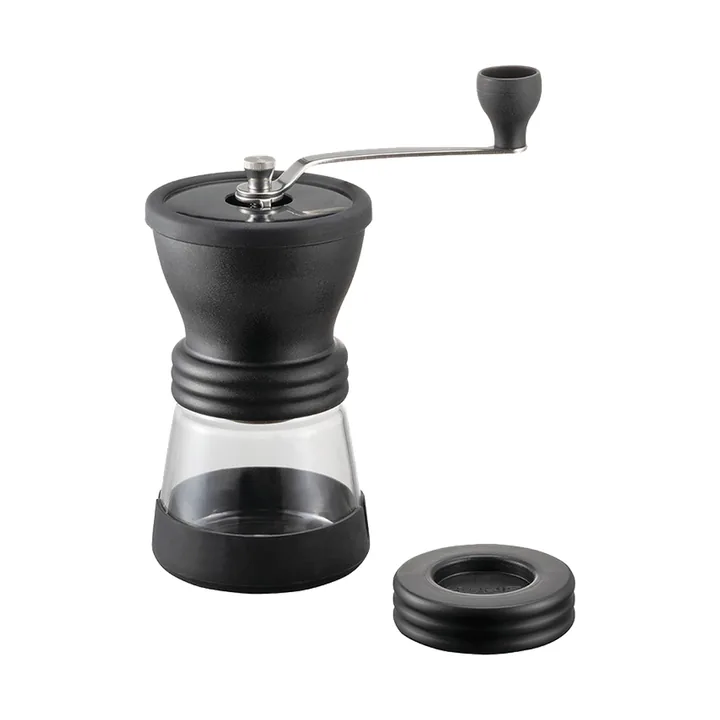 1
1CHEAPEST HONEST BURRS
The grinder almost everybody starts with, and it earns its place here by being honest about what it is. Ceramic burrs, a glass jar, a handle that comes off, and a hundred grams of ground coffee in the bottom. It will make you good French press and good pour-over for years and it costs less than two bags of the beans on our shelf. What it will not do is hold a setting: the adjustment is a nut under the burr with no clicks and no numbers, so 'yesterday's grind' is a thing you find again by taste, not by counting. HARIO says nothing about espresso anywhere on their page for it, and that silence is the most accurate spec on this row.
- Burrs Conical ceramic burrs, which C4 Coffee's listing says 'transfer less heat and shave coffee beans versus cracking them like blade grinders'
- Adjustment 'Its settings are easy to adjust' — no clicks, no numbers, no step size given†
- Weight and size About 650 g including its box; 173 x 96 x 210 mm†
- Also stated Heatproof glass bowl, polypropylene body and hopper, stainless steel handle, silicone non-slip cover; a redesigned lower bottle 'for improved stability'; holds 100 g of ground coffee†
- Not stated Fine enough for espresso?
† from Hario’s own page for this grinder, read 6 Sep 2026; the rest is the shop’s listing.
Photo: Hario, the maker's own product picture, via hario-europe.com.
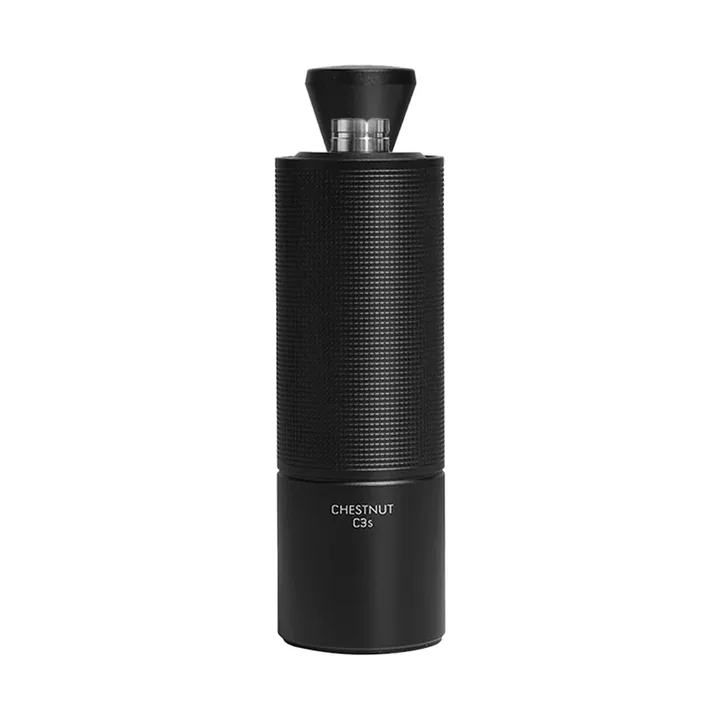 2
2OUR PICK
The one that quietly ended the argument for most people. Steel burrs on dual bearings, ninety clicks of adjustment you can count and return to, an aluminium body that survives a bag, and a fabric case, for a hundred and sixty dollars from a roaster's own shop. It grinds a filter dose in well under a minute with no drama. Timemore's own page says it is fine enough for espresso, and at the coarse end of espresso, on a forgiving machine, that is true — but ninety clicks across the whole range is a wide step down where espresso actually lives, and you will feel that as shots that move when you did not move anything. For everything that is not espresso it is the most grinder per dollar on this page by a distance.
- Burrs Stainless steel S2C ('Spike to Cut') burrs, 'which help reduce the creation of fine particles'
- Fine enough for espresso? 'Built for Espresso to French Press. Fine enough for espresso. Coarse enough for immersion brews.'†
- Adjustment 'Dial in from 0 to 90 clicks'†
- Weight and size 540 g; 147 mm tall and 52 mm wide, handle 159 mm
- Also stated Aluminium alloy and stainless steel; capacity one cup of coffee (25 g); cleaning brush, fabric carry case and a user manual with the warranty in it
† from Timemore’s own page for this grinder, read 6 Sep 2026; the rest is the shop’s listing.
Photo: Timemore, the maker's own product picture, via timemore.com.
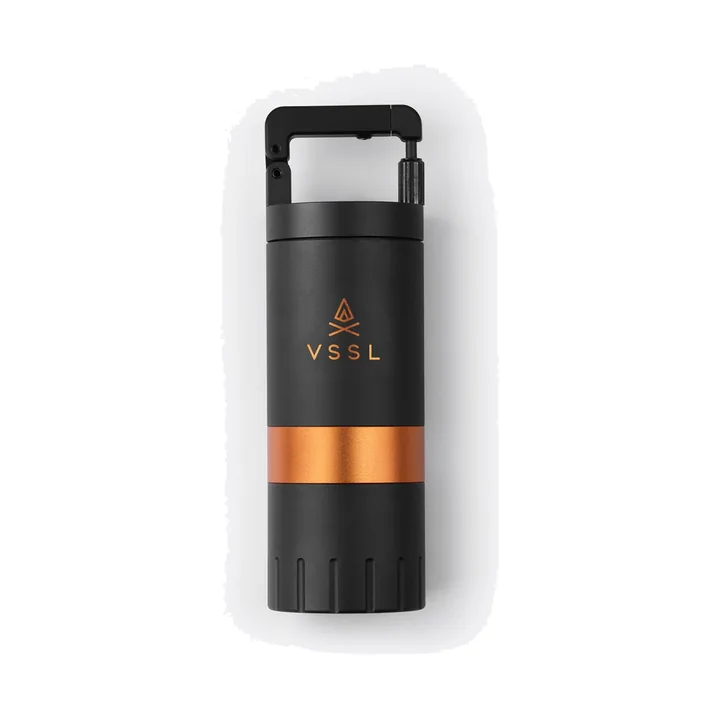 3
3GOES IN THE PACK
The one built for the outside of a pack rather than the inside of a cupboard, and the only grinder here whose shape is an argument. The handle folds down into a carabiner, the knob screws into the catch so there is nothing loose to lose in a tent, and the whole thing drops inside an AeroPress Go — which is the brewer we picked in the portable brewers battle, so that is not a coincidence anybody should ignore. Fifty settings and hardened steel burrs put the grind somewhere between the Timemore and the Comandante. Neither VSSL nor the shop mentions espresso, which for a grinder sold to people standing on a hill is the correct silence. At $315 you are paying for aluminium, ball bearings and the fact that it will still work after you drop it.
- Burrs High carbon 420 tool stainless steel conical burrs on dual axle bearings
- Adjustment 50 grind dial settings
- Weight and size 362 g; 165 mm tall x 50.8 mm diameter
- Also stated Machined aircraft-grade aluminium and stainless steel; a locking carabiner that extends into the grind handle; push-button release top cap; the knob stows in the catch; 30 g grind capacity; brush and felt case; 'compatible to fit inside the VSSL Nest Pour Over Kit and AeroPress Go'
- Not stated Fine enough for espresso?
Photo: VSSL, the maker's own product picture, via vsslgear.com.
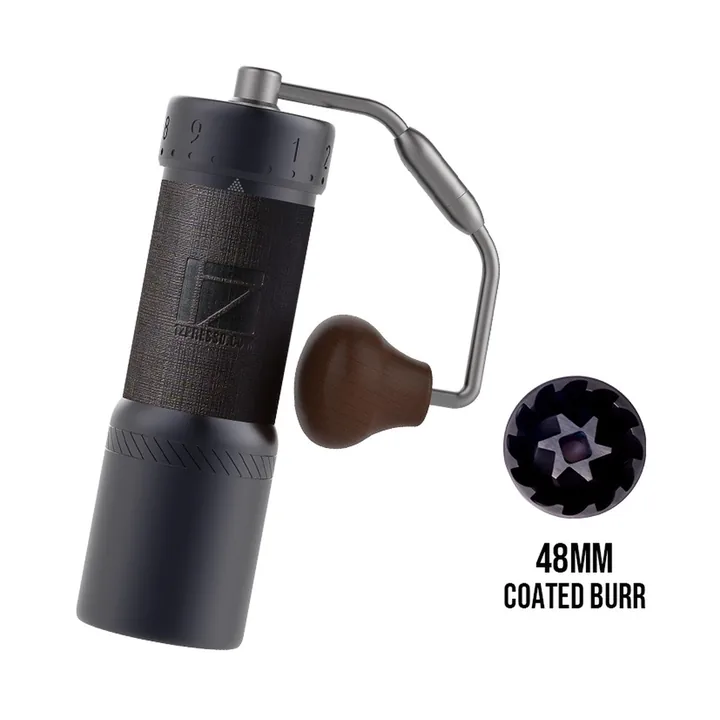 4
4FOR ESPRESSO
The one that crosses the line, and the only row on this page where espresso is a number rather than an adjective. Eight microns a click, on a ring you turn on the outside of the grinder without taking anything apart, which means you can chase a shot while it is still in front of you. The burrs are cut for espresso and it shows in the speed: it eats an 18 g dose faster than the cheaper grinders eat a filter dose, because espresso burrs are aggressive and this is where that pays. It is 700 g, it is $389.95, and if you do not pull espresso it is more grinder than your kettle deserves. If you do, it is the cheapest thing on this page that will not quietly ruin your mornings.
- Burrs 48 mm coated burr, which the shop says is 'optimized for espresso'
- Fine enough for espresso? 'A premium manual coffee grinder designed for coffee lovers who demand exceptional consistency, especially for espresso'
- Adjustment External adjustment ring, 8 microns per click — 'the most precise adjustment among all 1Zpresso models'†
- Weight and size 700 g; 19 x 18.5 x 5.5 cm
- Also stated Foldable crank; magnetic twist-off catch cup holding 35-40 g; tool-free dismantling; wood, polycarbonate, silicone, stainless steel and aluminium alloy; brush, blower and carrying case in the box
† from 1Zpresso’s own page for this grinder, read 6 Sep 2026; the rest is the shop’s listing.
Photo: 1Zpresso, the maker's own product picture, via 1zpresso.coffee.
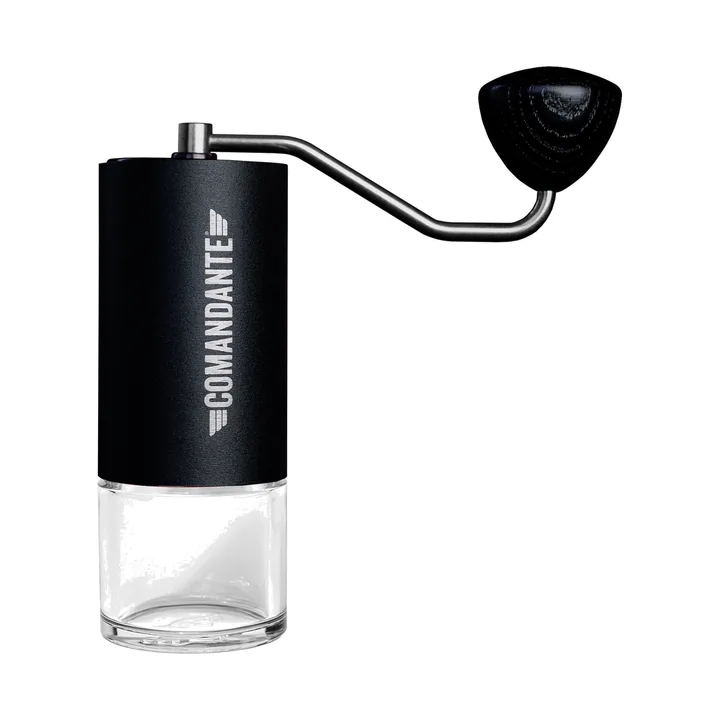 5
5KEEP IT FOREVER
The reference, and the row that made us write the section about dashes. It is the grinder that convinced the specialty coffee world a hand grinder could be a serious instrument, it is made in Germany out of a steel the founder had cooked in an Alpine valley, and people who own one still own it fifteen years later. It is also the only grinder here whose maker publishes neither a weight, nor a size, nor a number of clicks on the page where they sell it — at $515, on a page about what you can carry. What you get for the money is the burr and the bearings and the fact that nothing on it will wear out. What you do not get is a way to write your espresso setting down, which is why the people who use one for espresso buy a $70 accessory to make the clicks smaller.
- Burrs Nitro Blade burr — 'a unique and groundbreaking burr'
- Fine enough for espresso? Comandante says their Nitro Rex steel 'ensures the consistent precision and durability that is appreciated worldwide - whether for the finest espresso or coarse filter coffee'†
- Also stated Two 40 g bean jars, one dark glass and one 'basically unbreakable' polymer; oak-knobbed crank; wrist band; merino wool felt mat; made in Germany
- Not stated Adjustment, Weight and size
† from Comandante’s own page for this grinder, read 6 Sep 2026; the rest is the shop’s listing.
Photo: Comandante, the maker's own product picture, via comandantegrinder.com.
How we check
One shop, one day, one shelf price each — this is a comparison you can check in a click, not a survey of the whole country. Prices read at each shop on 6 Sep 2026 and not checked since — 50 days ago, so check before you buy.
One grinder per reader. Change your mind as often as you like - the last pick is the one that counts, and the scoreboard is every reader's pick added up.
No votes counted yet.
What we store
A pick is stored against a salted hash of your address, never the address itself. Same machine, same household, same office: one pick. Clearing your cookies or opening a private window does not buy a second one; the server is the record, and it keeps the last pick it was sent. The scoreboard on the page is counted from those picks each night and refreshed when you open the page.
A hand grinder is the cheapest large improvement available to anybody drinking coffee at home, and it is also the piece of gear most likely to end up in a drawer. Both facts have the same cause: it is a machine that trades money for effort, and the exchange rate is steep. Every hundred dollars you do not spend, you pay back in seconds of cranking, in mornings, forever.
So this page is not a burr-size league table. Five grinders, five makers, four New Zealand shops, and one question asked of each: what does it actually cost you to use? Every price is a real shelf price read by hand on the same day, and where a shop and a maker disagree about a fact — which happened more than we expected — we say so rather than pick the flattering number.
Why these five
Five, and they are a ladder of how seriously you have taken this. The one you buy first and give away later (the Hario Skerton N). The one that is quietly enough grinder for most people who are honest about what they drink (the Timemore Chestnut C3S). The one built for a pack rather than a bench (the VSSL Java G25). The one that crosses the line into espresso and can prove it with a number (the 1Zpresso J-Ultra). And the one people keep for twenty years and hand on (the Comandante C40 MK4).
Espresso is why they are ordered this way rather than by burr size. A hand grinder can be fine enough for espresso or it can be pleasant to use, and under about $300 in New Zealand it is very rarely both. Three of these five will make good filter coffee for the rest of your life. Only one of them has a maker who will put the word espresso next to a number, and it is not the dearest one on the page.
New Zealand stock was a hard filter and the shops did the cutting. Timemore's Chestnut C3 and C3 ESP were sold out at four of the six shops we looked at on the day, which is why the row is the C3S from Allpress — in stock, $160, and from a roaster whose beans are already on our shelf. Comandante's C40 is stocked here in at least four finishes at four different prices, $510 to $599, and the one we could actually buy on the day was Atomic's Nitro Blade in black. Considered and not given a row: Porlex's Mini II ($120 at Chiasso and at Ozone, and the one that famously packs inside an AeroPress) because Porlex publishes no product page of its own we could credit a photograph to; Mazzer's Omega ($714 at Chiasso), which is a bench-grinder maker's hand grinder and a different argument; Varia's Evo Hybrid ($499 at C4 Coffee); and the $45 supermarket mills, which are not cheap grinders but a different object with a similar shape.
- OUR PICKChestnut C3S
Steel burrs, ninety countable clicks, an aluminium body and a carry case for $160, in stock at a roaster whose beans are on our shelf. Unless you are pulling espresso, everything above it on this page is buying you refinement rather than coffee.
- FOR ESPRESSOJ-Ultra
Eight microns a click on an external ring. The only grinder here where 'fine enough for espresso' is a measurement instead of a mood.
- CHEAPEST HONEST BURRSCeramic Coffee Mill Skerton N
Ninety-two dollars for real conical ceramic burrs and a glass jar. It cannot hold a setting and it never claimed to.
- GOES IN THE PACKJava G25
The handle is a carabiner, nothing comes loose in a tent, and it fits inside an AeroPress Go — which is the brewer we picked in the portable brewers battle.
- KEEP IT FOREVERC40 MK4 Nitro Blade
Fifteen years of people not replacing theirs is a specification, even if Comandante will not publish any of the others.
Two flat whites a day at 18 g a shot is 13.1 kg of beans a year. At $6.80 per 100 g — the median of the 2,867 bags in stock on our shelf right now — that is about $894 a year of coffee, every year, whichever grinder is doing the work.
Most people buying a hand grinder for espresso should not be buying a hand grinder. Espresso needs a fine grind held to a repeatable step, and holding a step is exactly what a machine you take apart to adjust is worst at. Under $300 in New Zealand you are choosing between grinders that go fine and grinders that go back to where they were, and only above that price does anybody sell you both.
The other unpopular part: the effort is the specification nobody prints. A cheap grinder on an espresso setting is ninety seconds of real work before breakfast, every day, and ninety seconds is how a $92 grinder becomes a $92 grinder in a drawer next to a $400 machine. If you are grinding for filter, all five of these are pleasant. If you are grinding for espresso, only two of them are, and one of those two costs more than the espresso machine most people own.
So: if you drink filter, plunger or AeroPress, buy the Timemore C3S and stop reading. If you are going up a hill, the VSSL. If you pull espresso, the 1Zpresso J-Ultra and nothing cheaper. If you want the last grinder you will ever buy and you accept that it will not tell you its own weight, the Comandante. And if you are not sure you will stick with this, the Skerton N is ninety-two dollars and there is no shame in finding out cheaply.
The line that runs through this page
Every hand grinder is sold as though the grind range were the point: coarse for plunger, fine for espresso, one machine covers it. It is the wrong way to read them. Every grinder here will produce fine powder if you turn the burrs close enough together. What separates them is whether you can put the setting back where it was, and whether the smallest change you can make is small enough to matter.
That is why 'fine enough for espresso' is a column and why two of the five rows are empty in it. Espresso lives inside a range so narrow that the useful question is how much the grind moves for one click. The J-Ultra answers that with a number — eight microns — and the Timemore answers it with ninety clicks across everything from espresso to French press, which sounds precise until you work out how much ground each click has to cover. The Skerton answers with a nut and no numbers at all. None of these are lies. They are three completely different products wearing the same category name.
What you are buying is the burr — and what it costs you is your arm
The burr set is nearly the whole difference in the cup. Ceramic is cheap, does not rust and is brittle; hardened steel cuts more cleanly, holds an edge for years and costs more to make. Bigger, sharper, better-aligned burrs on real bearings do the same job with less force and fewer fines — the dust that makes a brew taste muddy — which is what you are actually paying for as the prices climb up this page.
The part the reviews skip is that the same upgrade is what makes the thing bearable. An 18 g espresso dose through cheap ceramic burrs is a genuine arm workout; through the J-Ultra's coated 48 mm espresso burrs it is over before you have finished thinking about it. Effort is a specification, it is the one you will meet every single morning, and not one of the five shops or makers on this page publishes it.
Retention — the coffee that stays inside the grinder instead of coming out — is the other unpublished number. Every hand grinder holds some; a gram of yesterday in today's dose is worth caring about at espresso doses and worth nothing at all in a plunger. Nobody here states it, so we have not put a column of guesses on the page.
Nobody agrees what these weigh
On a page about what you carry, we expected the weights to be the easy part. They were the worst. The Coffee Collective lists the VSSL Java G25 at 362 g; VSSL's own page for the same grinder says 15.2 oz, which is 431 g. The Coffee Collective lists the J-Ultra at 700 g; 1Zpresso's own comparison table says 670 g. Comandante publishes no weight for the C40 at all, and neither does the shop selling it. Three of five rows, one simple fact, and no agreement.
So the table prints the shop's number by default, because the shop is who you are buying from, and marks with a dagger anything taken from the maker's own page for that exact grinder — read the same day, linked under the row. Where a line is missing it means neither of them said. It does not mean the grinder does not have one. We would rather show you the hole than fill it in from a review.
Why there are no bench grinders here
Because a hand grinder is bought for the bench you have not got — the campsite, the office drawer, the overnight bag, the flat where a burr grinder would wake the house — and the trade it makes is your arm for the motor. Ranking a Comandante against a Niche on price tells neither buyer anything they need to know.
The bench and electric grinders have their own battle, argued on their own terms, and it makes the case for why the grinder decides the cup at greater length than we have room for here.
What you are grinding into
A hand grinder is half a purchase. The other half is what the coffee falls into, and if you are buying one of these you are probably buying it to use somewhere without a kitchen — which is a different set of brewers with a different set of arguments.
The VSSL says the quiet part out loud by publishing that it fits inside an AeroPress Go. That is the brewer we picked in the portable brewers battle, and the pairing is genuinely the least you can carry and still drink something good.
What New Zealand actually stocks
Hand grinders are the one piece of coffee gear New Zealand roasters actually stock, which is why these five come from four different shops and three of those are roasteries rather than appliance retailers. It also means stock moves: Timemore's Chestnut C3 and C3 ESP were listed at six shops on the day we read and available at two of them, and the Comandante C40 is sold here in at least four finishes between $510 and $599 depending on the colour of the paint.
The Hario is the one to be careful with. The same grinder has been sold here as the Skerton, the Skerton Plus and the Skerton N, the generations are not identical, and at least one New Zealand shop lists it under one name with the description of another. We cite the listing whose title names the generation, and it is worth checking which one is in the box before you buy — several roasters have a Skerton on the shelf between $80 and $95.
About the pictures
The photographs are the makers' own product pictures — Hario's, Timemore's, VSSL's, 1Zpresso's and Comandante's — taken from each maker's page for that exact grinder, set on the same white plate so they read as a set, and credited under each one. As on the portable brewers page, not one of these five gives us a licence to rely on: Timemore and VSSL reserve their rights in the same words, Hario Europe's terms and Comandante's terms say nothing about images at all, and 1Zpresso publishes no terms of service whatsoever. None of the five has a press kit. We show them the way a review shows the thing it is reviewing: at the maker's own size and finish, saying whose they are, on a page that earns nothing from any link on it. 1Zpresso's only plain product picture of the J-Ultra is a composed one with their own burr inset and its label beside the grinder; we left that in, because taking things out of somebody else's photograph is not ours to do.
If you are one of those makers and would rather we did not, tell us through the tip form on the front page and the picture comes down the same day. No retailer's photography appears here.
About these prices
One retailer each, four different shops, read by hand on 6 September 2026, with the link so you can check it yourself in one click. It is not a survey of the country and it is not live — the shelf of beans on this site updates every night, this page does not. Three of the four shops are roasteries: C4 Coffee and Atomic Coffee Roasters are both already on our shelf, and Allpress is not, which is its own small argument about who bothers to stock a hand grinder. The Coffee Collective is a gear specialist and the only shop here with two rows.
Nothing on this page is sponsored and no link here pays us. If that ever changes it will say so on the line above the contenders, in that order: the disclosure first, the recommendation second.