Battle of the home machines
Five machines you can buy new in New Zealand today, from $298 to $7,299. Real shelf prices, the makers' own pictures, an opinion we will put our name to — and your vote decides the champion.
 1
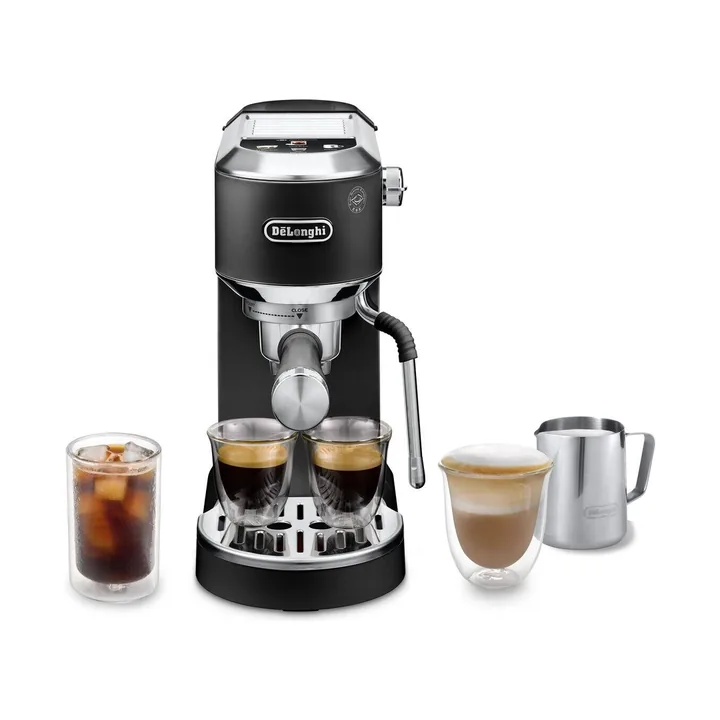
1CHEAPEST WAY IN
The cheapest door into real espresso, and the narrowest machine here by a distance. It has no grinder, which on this page is a feature: it forces you to buy the thing that actually changes the cup.
- Milk My LatteArt steam wand, worked by hand
- Also stated 15 cm wide; three presets including a five-minute cold brew
- Not stated Grinder, Portafilter, Heat-up
Photo: De'Longhi, the maker's own product picture, via delonghi.com.
 2
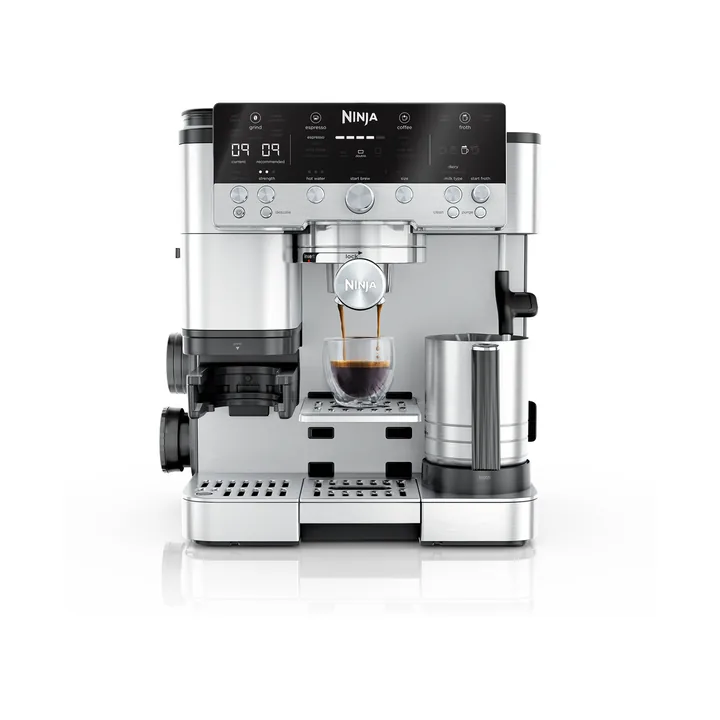
2THE OUTSIDER
The outsider, and the only machine here that watches what you did last time and tells you to grind finer. On the day we read it the shop had it marked down from $798, which puts a grinder-in-the-box machine fifty dollars under the Barista Express. You still tamp. If you want one appliance that does espresso, filter and cold brew, this is the one that admits it.
- Grinder Built in, conical burr, 25 settings, weight-based dosing
- Milk Steam wand
- Also stated Also makes filter coffee and cold brew; suggests a grind size based on your last shot
- Not stated Portafilter, Heat-up
Photo: Ninja, the maker's own product picture, via sharkninja.co.nz.
 3
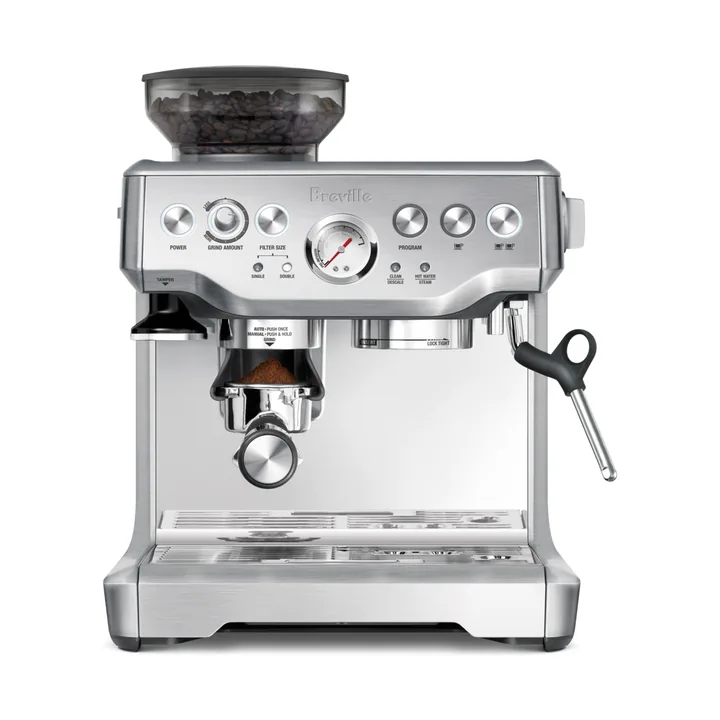
3OUR PICK
The machine that sold a generation of New Zealanders on home espresso, and the only one here with a grinder in the box that still hands you the tamper. Everything that makes the shot good — the dose, the tamp, the grind you dial in — is yours to get right, which is why it is our pick and why the Impress is not on this page.
- Grinder Built in, conical burr, 16 settings, dose control†
- Milk Steam wand, worked by hand†
- Portafilter 54 mm, 18 g dose; single- and dual-wall baskets in the box†
- Heat-up Thermocoil with PID temperature control
- Also stated Low-pressure pre-infusion, 15 bar pump, 1700 W, dedicated hot-water outlet, 2 L tank with filter
† from Breville’s own page for this machine, read 5 Sep 2026; the rest is the shop’s listing.
2 picks · 67%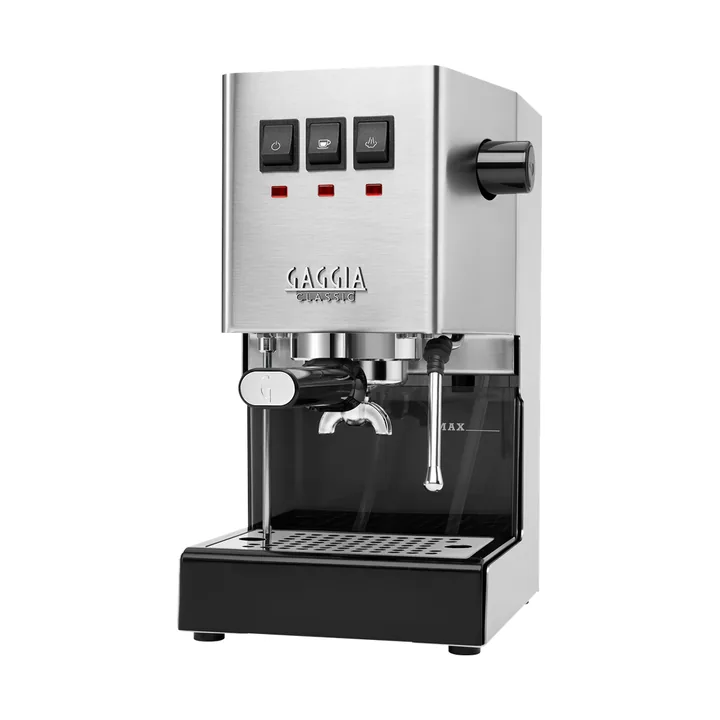 4
4THE PURIST'S BOX
The purist's box. A 58 mm commercial group, a boiler the size of a coffee cup, three rocker switches and nothing else — which is exactly why people keep one for fifteen years and modify it. No grinder, so add a good one and you are past the Barista Express's price with a much better machine and a much steeper first month.
- Milk Commercial steam arm on a ball joint
- Portafilter 58 mm commercial group and filter-holder, two-cup
- Heat-up About five minutes from cold; 130 mL boiler, 1200 W
- Also stated 2.1 L tank; 15 bar Ulka vibration pump; 7.3 kg; made in Italy; 12-month warranty
- Not stated Grinder
Photo: Gaggia, the maker's own product picture, via gaggia.com.
 5
5THE DREAM
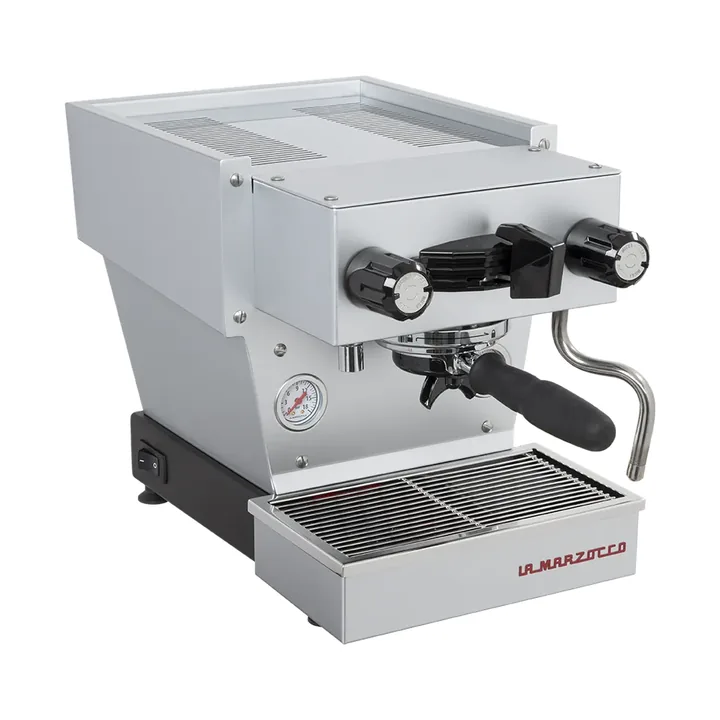
A cafe machine shrunk to 29 cm wide: two boilers, a rotary pump, and a portafilter that fits every La Marzocco ever made. It is very, very good. It is also $7,001 more than the Dedica Duo, and it will not make a stale bean taste fresh.
- Grinder None — sold separately
- Milk Steam wand off its own 1.6 L steam boiler
- Portafilter 58 mm convertible portafilter (single, double or bottomless); 14 g and 17 g baskets
- Heat-up Dual boiler, dual PID; a quick heat-up, no number given
- Also stated Rotary pump; 34 × 29 × 39 cm, 19 kg; 1.5 L tank; warranty is for domestic use only
Photo: La Marzocco, the maker's own product picture, via nz.lamarzoccohome.com.
1 pick · 33%
How we check
One shop, one day, one shelf price each — this is a comparison you can check in a click, not a survey of the whole country. Prices read at each shop on 5 Sep 2026 and not checked since — 51 days ago, so check before you buy.
One machine per reader. Change your mind as often as you like — the last pick is the one that counts, and the scoreboard is every reader's pick added up.
3 picks so far. the Barista Express leads with 67%.
What we store
A pick is stored against a salted hash of your address, never the address itself. Same machine, same household, same office: one pick. Clearing your cookies or opening a private window does not buy a second one; the server is the record, and it keeps the last pick it was sent. The scoreboard on the page is counted from those picks each night and refreshed when you open the page.
Every machine on this page can pull a good shot. Not one of them can pull a good shot from stale beans ground a week ago, and that is the whole argument: the machine is the part of this decision that matters least. So we ranked five of them honestly, and then we tell you where the money actually goes.
Why these five
Five, not eight, and not the five bestsellers. Each one is a different answer to the only question that matters at a bench: who does the grinding and the tamping? Nobody — you buy a grinder and learn on a bare machine (the Dedica Duo at the bottom of the ladder, the Classic Evo Pro and the Linea Micra at the top). The machine grinds and weighs, you tamp (the Barista Express, the Luxe Cafe).
One Breville, and it is the Barista Express rather than the Impress or the Oracle: coffee people are purists, and a lot of making good coffee is preparing the puck. The Impress tamps for you; the Oracle Jet grinds, doses and tamps for you. Both are fine machines and both take away the part a purist wants to own, so the Breville on this page is the one that hands you the tamper. The other four are other makers, because a battle of five Brevilles is a catalogue.
Every one is sold new in New Zealand today, and together they run $298, $648, $698, $1,250 and $7,299, so the price ladder is the argument laid out on a shelf. Yes, the top rung is a cafe machine's price. It is here because people ask about it, and because the honest answer to "is it twenty-four times better than the Dedica?" is on this page.
- OUR PICKthe Barista Express
One box, a real grinder, and the puck is yours to prepare. It is the machine most New Zealanders learned on for a reason: the grinder is good enough to teach you what a grind change does, and nothing in it does the learning for you.
- CHEAPEST WAY INDedica Duo EC890
Under three hundred dollars and fifteen centimetres of bench. If you are not sure you will still care in a year, start here — and put the money you did not spend into a grinder.
- THE OUTSIDERLuxe Cafe
Not a Breville, not Italian, and the only one here that coaches your next shot off your last one. Espresso, filter and cold brew from one box, at a price that has just moved under the Barista Express's.
- THE PURIST'S BOXClassic Evo Pro
A commercial 58 mm group and almost no electronics, so the shot is entirely your doing and the machine will outlast the bench. Bring your own grinder, and your patience for the first month.
- THE DREAMLinea Micra
Nothing wrong with it. But the jump from $698 to $7,299 buys a cafe's consistency and a badge, not a better bean, and $6,600 of beans is a decade of drinking — the block below does that arithmetic off our own shelf.
Two flat whites a day at 18 g a shot is 13.1 kg of beans a year. At $6.80 per 100 g — the median of the 2,867 bags in stock on our shelf right now — that is about $894 a year of coffee, every year, whichever machine is doing the work.
Spend your money in this order: beans, grinder, machine. Not the other way round, which is the order the shop floor is arranged in.
Freshly roasted beans and a grinder that produces an even grind will make a $298 machine taste better than a $7,299 machine fed pre-ground supermarket coffee. Nothing on this page changes that, and no amount of PID temperature control changes that.
So: if you want one box, buy the Barista Express and learn to tamp — it is the only grinder-in-the-box machine here that leaves the puck entirely to you. If you want the best cup this money can buy, buy the Classic Evo Pro or the Dedica Duo and spend what you saved on the grinder and the beans. And if you already know you will be doing this in ten years, the Micra is waiting; it is a wonderful machine and it is not a shortcut.
Why there are no pod machines here
Because they are not the same purchase. A pod machine is a subscription with a lid on it: the machine is cheap and the coffee is expensive forever, and the comparison that matters there is the price per capsule, not the price of the box.
We track pods separately, on the roaster pages, where the shops that sell them publish what they cost. This page is about the machines where you choose the beans.
What a dash means
Every spec on this page is quoted from the shop's own published listing for that exact machine, or — where a line carries a dagger — from the maker's own page for it, read the same day and linked under the row. Where a line is missing, it means neither said, not that the machine cannot do it.
That is the same rule the rest of this site runs on: a gap in somebody's copy is a gap in their copy, and we would rather show you the hole than fill it in from memory. The Dedica Duo is the honest example: its listing names no portafilter size, so we print none, although there is plainly one in the box.
About the pictures
The photographs are the makers' own product pictures — Breville's, De'Longhi's, Ninja's, Gaggia's and La Marzocco's — taken from each maker's page for that exact machine, set on the same white plate so they read as a set, and credited under each one. Breville publishes its pictures under a Creative Commons licence (BY-NC-SA); the others reserve their rights, and we show them the way a review shows the thing it is reviewing: at the maker's own size and finish, saying whose they are, on a page that earns nothing from any link on it.
If you are one of those makers and would rather we did not, tell us through the tip form on the front page and the picture comes down the same day. No retailer's photography appears here.
About these prices
One retailer each, read by hand on one day, with the link so you can check it yourself in one click. It is not a survey of the country and it is not live — the shelf of beans on this site updates every night, this page does not. Three are JB Hi-Fi shelf prices; the Classic Evo Pro is My Espresso's and the Linea Micra is La Marzocco's own New Zealand shop.
Nothing on this page is sponsored and no link here pays us. If that ever changes it will say so on the line above the contenders, in that order: the disclosure first, the recommendation second.