Battle of the portable brewers
Five brewers you can buy new in New Zealand today, from $20 to $269. This is the country where everybody leaves the kitchen, so the question is not which one makes the best cup on a bench — it is which one still makes coffee at a hut, in a van, on a boat or in a drawer at work. Real shelf prices, the makers' own pictures, an opinion we will put our name to, and your vote decides the champion.
 1
1WEIGHS NOTHING
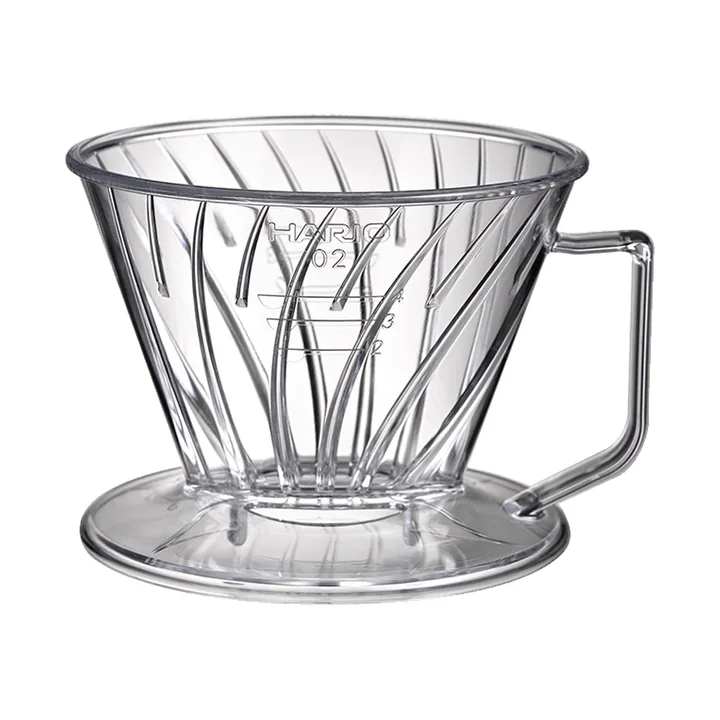
The one that weighs nothing and costs nothing. A hundred grams of clear resin that sits on your mug, your bottle or the lid of a billy, takes a paper filter and makes an honest cup of filter coffee for twenty dollars. It is the only brewer here you can genuinely forget you are carrying, and the only one with no seal, no battery and nothing to break. It also does the least: no pressure, no crema, and you must arrive with the hot water. On a tramp where every gram is argued over, that is not a compromise, it is the whole point.
- What it makes Pour-over filter coffee, 2-4 cups (02 size)
- What it needs Hot water you brought, a mug or bottle for it to sit on, and Pegasus paper filters ($9.95 at the same shop)
- Weight 100 g
- Size Trapezoid dripper, 02 size; ships in a 12 x 7 x 21 cm box†
- Also stated AS resin; two drip holes and spiral ribs for an even flow, a measurement scale on the cone, two view holes in the base so you can watch the brew rise, and a fit designed for most personal bottles and cups
† from Hario’s own page for this brewer, read 6 Sep 2026; the rest is the shop’s listing.
Photo: Hario, the maker's own product picture, via hario-europe.com.
 2
2OUR PICK
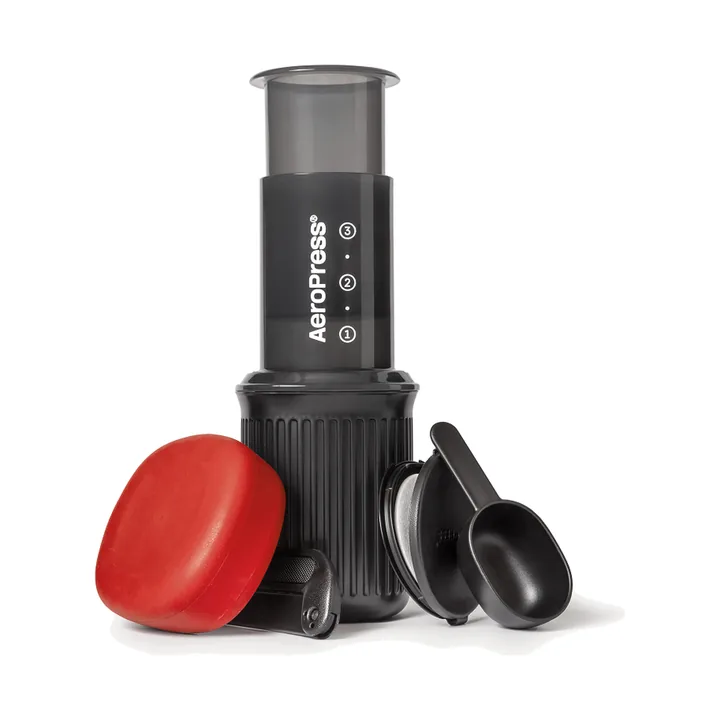
The one to buy if you are only buying one. Everything packs into its own mug, it makes a cup that beats a plunger and most hotel machines, it cleans in about ten seconds by pushing the puck into a bin, and there is nothing on it to break. Ozone Coffee is the New Zealand importer and had it at $89.95 on the day, cheaper than the specialists. Its limits are honest: 8 oz, one cup at a time, and it is not espresso no matter what the internet tells you. For a hut, a tent, a hotel room or a desk, it is the correct answer and we are not going to pretend otherwise.
- What it makes Coffee 'like the original, only more compact and designed to travel': one cup, fast immersion plus air pressure, micro-filtered
- What it needs Hot water you brought, and a standard-size paper micro-filter†
- Weight 11.4 oz (323 g) packed in its mug with the lid, the accessories and 20 filters†
- Size 4.5" H x 3.6" W†
- Also stated Polypropylene and silicone; BPA free; packs away into its own microwaveable mug, which is the travel container; dishwasher safe, top rack only; brew and clean in two minutes; one-year warranty†
† from AeroPress’s own page for this brewer, read 6 Sep 2026; the rest is the shop’s listing.
Photo: AeroPress, the maker's own product picture, via aeropress.com.
 3
3REAL ESPRESSO
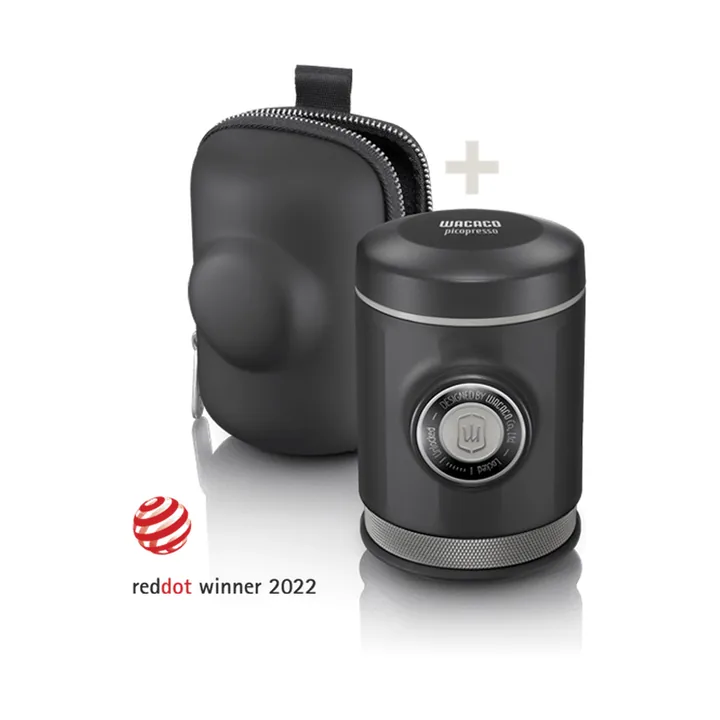
The one that actually makes espresso, and the one that will punish you for it. Eighteen grams, a naked portafilter, 18 bar from your hand, and a shot that will genuinely embarrass a lot of home machines. It also demands a grind you cannot get from a supermarket bag or a cheap hand mill, a tamp, and about four minutes of attention while your friends drink instant. Three hundred and fifty grams is nothing in a pack. The grinder you will have to buy to feed it is not, and the honest price of this row is closer to $500.
- What it makes Cafe-quality espresso from 18 g of ground coffee through a naked portafilter and a 52 mm stainless basket
- What it needs Hot water you brought, an espresso-fine grind, and your own tamping and pulling technique - there are no shortcuts
- Weight 350 g
- Size 106 x 78 x 71 mm
- Also stated 80 ml water capacity, 18 g grounds, max 18 bar; double filter basket, tamper, scoop, brush, distribution tool, funnel and a protective case in the box
Photo: Wacaco, the maker's own product picture, via wacaco.com.
 4
4BASE CAMP
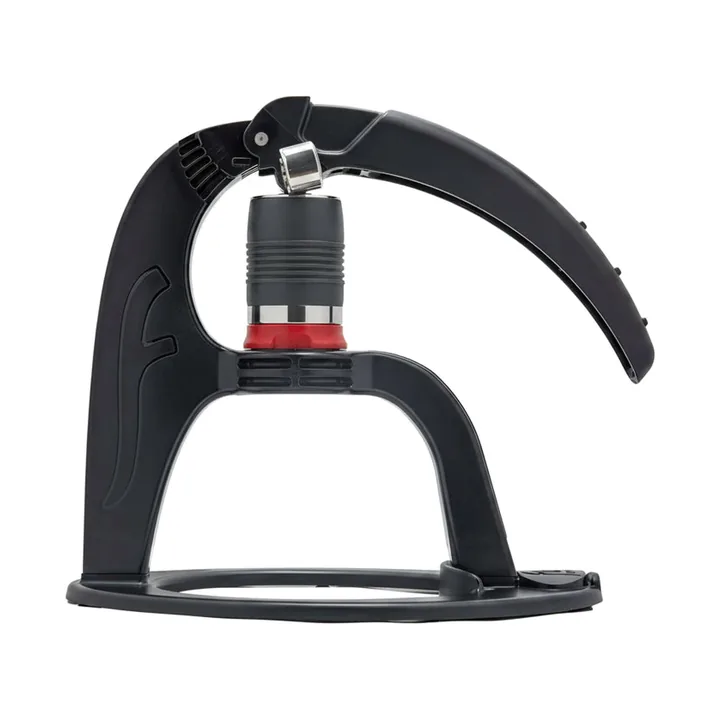
The bach machine, not the pack machine. A lever, a gauge and a thin-walled cylinder that skips the preheat, and it will pull a better shot than the Picopresso with less swearing because you can see the pressure you are making. But nobody publishing it in New Zealand will tell you what it weighs: Chiasso does not say, and Flair does not say. Di Pacci, selling the earlier non-V2 Flex at $251.99, puts that one at 3.18 kg and 29 cm tall, which tells you the shape of the thing. Buy it for a bach, a van with a bench or an office you actually own. Do not buy it to carry.
- What it makes Espresso by lever, with two portafilters in the box: a Flow-Control one whose restricted exit port builds the pressure for you, and a Bottomless 2-in-1 for full control
- What it needs Hot water you brought and your own arm - 'no boiler, no pump, no power point'. The bottomless portafilter needs an espresso-capable burr grinder
- Also stated Custom pressure gauge; no-preheat thin-walled brew cylinder; high-strength ultra-light polymer frame; dosing cup, funnel and preheat cap included; optional dual-chamber carry case with a foam barrier, $259 the pair
- Not stated Weight, Size
Photo: Flair, the maker's own product picture, via flairespresso.com.
 5
5NEEDS NO KETTLE
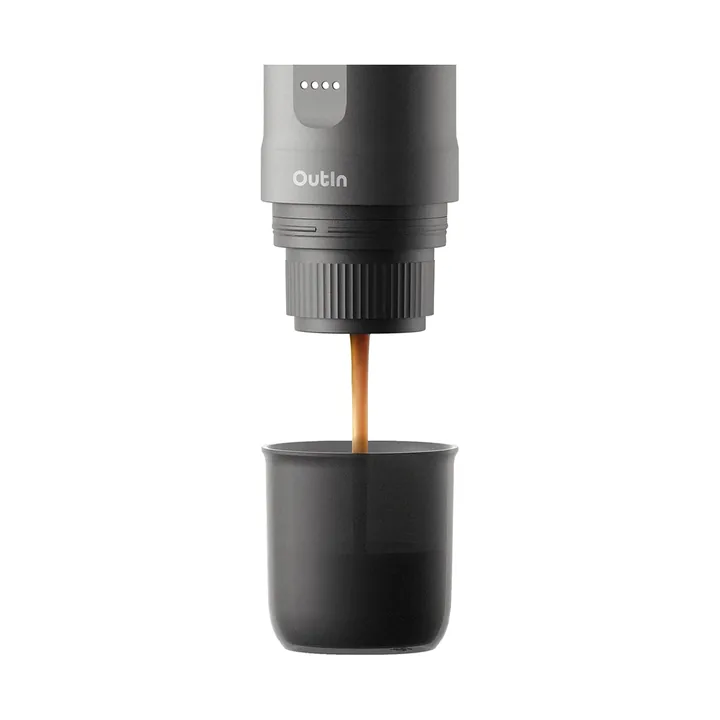
The only one here that does a job none of the others can do: make coffee where there is no hot water. Fill it from a stream or a tap, wait three minutes, and it heats and pulls its own shot from a 12 V socket's worth of charge. That is the boat, the ute, the campsite with no fire and the roadside at 6 am. The price of that trick is 670 g, an 8 g basket that is small for a real double, a battery to keep charged and a machine with electronics in it going into a wet pack. If you already carry a thermos of boiling water, buy something simpler.
- What it makes Espresso at up to 20 bar from 8 g of ground coffee or a Nespresso-compatible capsule
- What it needs A charge, and that is all: it heats cold water itself in about 200 seconds and reaches up to 92 C. Give it hot water and it extracts straight away
- Weight 670 g
- Size 7.3 x 23.0 cm
- Also stated 80 ml water, max 8 g grounds; 90 W, 7500 mAh battery good for 5 cold-water brews or over 200 hot; charges from USB-C or a 12 V / 24 V car socket; IPX4; food-grade stainless tank; Red Dot 2023 and a 2024 World Coffee Innovation award
Photo: OutIn, the maker's own product picture, via outin.com.
How we check
One shop, one day, one shelf price each — this is a comparison you can check in a click, not a survey of the whole country. Prices read at each shop on 6 Sep 2026 and not checked since — 50 days ago, so check before you buy.
One brewer per reader. Change your mind as often as you like - the last pick is the one that counts, and the scoreboard is every reader's pick added up.
No votes counted yet.
What we store
A pick is stored against a salted hash of your address, never the address itself. Same machine, same household, same office: one pick. Clearing your cookies or opening a private window does not buy a second one; the server is the record, and it keeps the last pick it was sent. The scoreboard on the page is counted from those picks each night and refreshed when you open the page.
There is a version of this page written for a flat in a city where the power never goes off, and it is not much use here. New Zealanders take coffee up hills, into huts with no plug, onto boats, into vans, and to a desk where the only kettle is shared with forty other people. What matters then is not burr size or bar pressure. It is whether the thing survives being packed, whether you have to carry the water hot, and whether you will still bother on the fourth morning.
So we judged these five on use. Every one of them is stocked new in New Zealand — we checked, because several of the famous names are not — and every price is a real shelf price from a named shop, read by hand on the same day.
Why these five
Five, and each one answers a different question about where you are standing. In a hut with a billy on the gas and no room for anything (the Pegasus). In a tent, a hotel or a car, wanting one properly good cup and nothing to wash up (the AeroPress Go). At a table, wanting real espresso and willing to work for it (the Picopresso). At a bach or in a van with a bench and a kettle, wanting espresso with a gauge on it (the NEO Flex). Or nowhere near hot water at all, which is the one job only a battery can do (the OutIn Nano).
New Zealand stock was a hard filter and it cut real names. Wacaco's Nanopresso — the famous one — is listed here at $119.95 and was out of stock at the shop we read on the day, so we took the Picopresso instead: same maker, and the one that actually makes an 18 g cafe-style shot. Flair's own current travel machine, the 2GO, has no New Zealand stockist we could find; what New Zealand sells is the NEO Flex, which Flair's own storefront now lists only as a refurbished unit. Bodum's Travel Press is a genuinely good plunger-in-a-mug at $39.95 and we cut it because bodum.com refuses to serve us at all, so we could neither read their terms nor take their own picture — and a page that shows makers' photographs cannot make an exception for the one maker who will not talk to us.
Together they run $19.95, $89.95, $204.95, $229 and $269, which is the argument laid out as a ladder: the cheapest brewer here is a fifth the price of a night in a hut, and the dearest is the only one that does not need you to arrive with hot water. Considered and not used: Cafflano, whose Kompresso ($131.99) and Kompact ($130.99) are both stocked at Di Pacci and would be the sixth row if there were one; the AeroPress Original, XL and Go Plus, because one AeroPress per page and the Go is the travelling one; and every hand grinder, which is a different purchase and gets its own battle.
- OUR PICKAeroPress Go
The one we would put in almost anybody's pack. Good coffee, no ritual, no power, nothing to break, packs into its own mug and cleans in ten seconds. At $89.95 from the New Zealand importer it is also the least you can spend and still be pleased on the fourth morning.
- WEIGHS NOTHINGPegasus Dripper 02
A hundred grams and twenty dollars. If your pack is weighed before it goes on, this is the only row on this page that survives the argument.
- REAL ESPRESSOPicopresso
Eighteen grams, a naked portafilter and 18 bar from your hand. It makes the best cup here and it makes you earn every one.
- NEEDS NO KETTLENano
Heats its own water off a battery or a car socket. The only brewer here that works where there is no hot water at all.
- BASE CAMPNEO Flex V2
A lever with a gauge on it, for a bach, a van bench or an office. Genuinely portable in the sense that it has no plug, and about three kilos in the sense that matters to your back.
Two flat whites a day at 18 g a shot is 13.1 kg of beans a year. At $6.80 per 100 g — the median of the 2,867 bags in stock on our shelf right now — that is about $894 a year of coffee, every year, whichever brewer is doing the work.
Four of these five are worse than the coffee you already make at home, and that is fine, because none of them are competing with your kitchen. They are competing with instant, with a service-station flat white, and with going without. Judge them on that and the ranking changes completely.
The other unpopular part: on a trip, the grinder decides more than the brewer does. Pre-ground coffee is stale by day three and there is no brewer on this page that can rescue it. The Picopresso and the Flex will not work at all without a grind you can only get from a decent hand grinder, which is a $200-$400 purchase nobody puts in the budget - and it gets its own battle.
So: if you are buying one thing, buy the AeroPress Go and a bag of beans you grind in the morning. If your pack is weighed, the Pegasus. If there is no hot water where you are going, the Nano and nothing else will do. If you want real espresso in a tent and you accept the homework, the Picopresso. And if 'portable' means a bach bench rather than a hill, the NEO Flex is the nicest object here by some distance.
What we mean by portable
Not 'small'. Portable here means it survives being packed by somebody in a hurry, works where you are actually going, and does not quietly need a second thing you were not planning to carry. On that test a 350 g espresso maker that needs a $300 grinder is less portable than a 100 g cone that needs a paper filter, and we ranked them that way.
Three of these five need you to arrive with hot water, which in New Zealand usually means a gas billy or a hut kettle, and both of those are heavier than any brewer on this page. Only the Nano makes its own. That single fact separates the boat and the ute from the campsite more cleanly than any price does.
You still need a grinder
Every brewer here is fed by hand, and none of them ships with a way to grind. Pre-ground coffee bought at home is flat by the third morning of a trip, and the two espresso makers on this page will simply not extract properly on a supermarket grind at all - the Picopresso's own shop says so in as many words.
The hand grinders you would take - the Comandante, the 1Zpresso, the Timemore - are a different purchase with a different argument, and they get their own battle rather than a row here. If you want the case for why the grind decides the cup, the grinders battle makes it at length.
What New Zealand actually stocks
This is the part most travel-coffee writing skips, because most of it is written somewhere else. Several of the brewers you will be recommended online are not sold here at all, and a recommendation you cannot act on is not a recommendation. Flair's current travel machine, the 2GO, has no New Zealand stockist we could find; what the shops here sell is the older NEO Flex, which Flair's own site now lists only as a refurbished unit. Wacaco's Nanopresso is stocked but was sold out in every colour at the shop we read on the day.
Where a brewer is import-only we have said so in the selection rather than given it a row, and where a New Zealand shop is the maker's own importer - Ozone, for AeroPress - we have said that too, because it usually shows in the price.
What a dash means
Every spec on this page is quoted from the shop's own published listing for that exact brewer, or - where a line carries a dagger - from the maker's own page for it, read the same day and linked under the row. Where a line is missing, it means neither said, not that the brewer does not have one.
The NEO Flex is the clearest case: on a page about what you can carry, neither the shop selling it nor the maker publishes a weight. We would rather show you that hole than fill it in from a review.
About the pictures
The photographs are the makers' own product pictures - Hario's, AeroPress's, Wacaco's, Flair's and OutIn's - taken from each maker's page for that exact brewer, set on the same white plate so they read as a set, and credited under each one. Unlike the grinders battle, not one of these five gives us a clean licence: AeroPress's published terms say nothing about images at all, Hario Europe's say nothing either, and Wacaco, Flair and OutIn each reserve their rights in words that do not permit republication. We show them the way a review shows the thing it is reviewing: at the maker's own size and finish, saying whose they are, on a page that earns nothing from any link on it. Wacaco's picture carries their own Red Dot award mark, which we left alone - taking things out of somebody else's photograph is not ours to do.
If you are one of those makers and would rather we did not, tell us through the tip form on the front page and the picture comes down the same day. No retailer's photography appears here.
About these prices
One retailer each, read by hand on 6 September 2026, with the link so you can check it yourself in one click. It is not a survey of the country and it is not live - the shelf of beans on this site updates every night, this page does not. Three of the five come from The Coffee Collective, which carries the widest range of travel brewers of any New Zealand shop we looked at; the AeroPress is from Ozone, the New Zealand importer, at ten dollars less; and the Flair is from Chiasso in Devonport, who had the V2 in stock and were $23 under the other New Zealand listing of the older model.
None of these links earns us anything. If that ever changes, this page will say so in a line above the table before it changes anything else.